
Retail is no longer defined by the products a business sells. It is defined by how easily customers can discover products, compare options, complete purchases, receive orders, and get support across every channel. Retailers that rely on disconnected systems, manual processes, and outdated technology struggle to deliver that experience consistently.
Digital transformation in retail and ecommerce connects customer-facing channels with the systems that manage products, inventory, orders, payments, fulfillment, and business intelligence. It enables retailers to make faster decisions, reduce operational friction, improve customer experiences, and build a technology foundation that supports growth.
The commercial opportunity is substantial. U.S. retail e-commerce sales reached $340.2 billion in the second quarter of 2026, accounting for 17.1% of total retail sales on a seasonally adjusted basis (quarterly e-commerce sales data). As digital commerce grows, retailers need more than an online storefront. They need connected technology that keeps every part of the business working together.
This guide explains how retail digital transformation works, which technologies matter, the operational problems it solves, and how retailers can implement a transformation strategy that delivers measurable business results.
What Is Digital Transformation in Retail and E-commerce?
Retail digital transformation is the process of improving retail operations, customer experiences, and business decision-making through digital technologies, connected systems, and redesigned workflows. It covers the entire retail operation, from online product discovery and in-store transactions to inventory management, supply chain coordination, customer engagement, and financial reporting.
E-commerce digital transformation focuses on strengthening the digital commerce experience and connecting online sales with the wider business. This includes ecommerce platform modernization, personalized shopping experiences, automated order processing, payment integration, customer data management, and real-time inventory visibility.
A successful transformation does not simply replace manual work with software. It changes how information moves through the business, how teams operate, and how customers interact with the brand.
For example, a retailer operating physical stores and an online shop may maintain separate inventory records for each channel. Customers can order products that are unavailable, staff must reconcile stock manually, and managers cannot see accurate demand across the business. Connecting the ecommerce platform, point-of-sale (POS) system, enterprise resource planning (ERP) software, and inventory management tools creates a more reliable operational picture.
Retailers can build this connected foundation through retail software development, system integration, workflow automation, and carefully planned technology modernization. The result is a retail operation in which customer experiences and back-office processes support the same business goals.
Why Digital Transformation Matters in the Retail Industry
Customer expectations, competitive pressure, and operational complexity make digital transformation a strategic priority for retailers. Customers expect accurate product information, convenient payment options, reliable delivery estimates, consistent pricing, and support across online and offline channels. Meeting these expectations requires technology that works across the entire customer journey.
The value of transformation extends beyond online sales. It helps retailers manage stock, coordinate fulfillment, identify purchasing trends, improve marketing decisions, and measure profitability across channels.
1. Customers Expect Connected Shopping Experiences
Customers may discover a product on social media, research it on a website, visit a store to examine it, and complete the purchase through a mobile app. They expect product details, prices, promotions, and availability to remain consistent throughout that journey.
A strong retail omnichannel integration strategy connects these touchpoints instead of treating each channel as a separate operation. Customers can move between channels with less friction, while retail teams gain a clearer view of interactions and purchases.
Research published in the 2025 retail industry outlook reported that omnichannel shoppers spend 1.5 times more per month than shoppers using a single channel. This highlights the commercial importance of making digital and physical shopping experiences work together.
2. Disconnected Systems Increase Operational Costs
When ecommerce, POS, ERP, customer relationship management (CRM), warehouse management, and accounting systems operate independently, employees often duplicate work and resolve conflicting records manually.
These inefficiencies affect order processing, inventory accuracy, reporting, and customer service. Retail software integration connects systems so information can move between them reliably, reducing repetitive work and giving teams access to more consistent operational data.
3. Inventory Accuracy Directly Affects Sales and Customer Trust
Inventory errors create two costly problems: retailers may advertise products that are unavailable, or they may leave sellable stock undiscovered in another location.
Retail inventory management software connected to POS, ecommerce, warehouse, and purchasing systems helps retailers track stock movements and update availability across channels. Better inventory visibility supports replenishment decisions, reduces avoidable cancellations, and improves fulfillment planning.
4. Data Improves Merchandising and Business Decisions
Sales reports alone cannot explain every purchasing pattern. Retailers need to understand which products attract customers, which promotions generate profitable sales, where customers abandon purchases, and how demand changes by season or location.
Integrated analytics combine information from multiple systems to reveal these patterns. Retail teams can use these insights to refine product assortments, forecast demand, allocate inventory, and evaluate marketing performance.
5. Manual Work Limits Business Growth
A process that works for a small catalogue or a single store may fail when a retailer adds locations, products, sales channels, or fulfillment options.
Automation and scalable applications help businesses handle increasing transaction volumes without increasing manual workload at the same rate. A well-planned technology foundation also makes it easier to introduce new channels and services without rebuilding the entire operation.
Common Retail and E-commerce Challenges Digital Transformation Solves
Digital transformation should start with business problems, not a list of technologies. The right solution depends on where a retailer loses time, money, customers, or operational control.
| Business challenge | Operational impact | Digital transformation solution |
| Disconnected retail systems | Duplicate data entry, inconsistent records, and slow reporting | POS, ERP, CRM, ecommerce, and accounting integration |
| Inaccurate inventory | Overselling, stockouts, cancellations, and excess stock | Centralized inventory visibility and automated stock updates |
| Fragmented customer experience | Inconsistent pricing, promotions, and service across channels | Omnichannel commerce and unified customer data |
| Slow order processing | Manual handoffs, fulfillment delays, and processing errors | Order management automation and system integration |
| Limited customer insights | Weak segmentation and poorly targeted campaigns | Customer analytics, CRM integration, and business intelligence |
| Poor website performance | Friction during browsing, checkout abandonment, and lost sales opportunities | Ecommerce optimization and platform modernization |
| Manual reporting | Delayed decisions and inconsistent performance metrics | Automated reporting and analytics dashboards |
| Legacy software limitations | High maintenance effort and difficulty adding new capabilities | Application modernization and custom software development |
These problems often overlap. For example, inventory inaccuracies may originate in disconnected POS and warehouse systems rather than in the inventory application itself. Addressing the underlying integration problem creates a more durable improvement than adding another standalone tool.
Key Technologies Driving Digital Transformation in Retail
Retailers do not need to implement every new technology at once. They need an architecture that addresses current business priorities and supports future expansion.
1. Omnichannel and Unified Commerce Platforms
Omnichannel commerce connects customer interactions across websites, mobile apps, physical stores, marketplaces, and other sales channels. Integrated commerce takes this further by connecting core commerce data and processes across a coordinated platform or architecture.
A connected commerce environment helps retailers maintain consistent product information, pricing, promotions, customer records, and inventory availability. It also supports services such as buy online, pick up in store (BOPIS), ship-from-store, and cross-channel returns.
Retailers with complex channel requirements can combine commercial platforms with custom retail software development to address workflows that standard products cannot support efficiently.
2. Artificial Intelligence and Automation
AI in retail supports demand forecasting, product recommendations, customer service, fraud detection, merchandising, and operational decision-making. Automation handles repetitive processes such as order routing, inventory updates, notifications, and report generation.
Examples include:
- AI-powered inventory management: identifies patterns in sales and stock movements to support replenishment decisions.
- Retail demand forecasting: estimates future demand using historical sales, seasonality, promotions, and other available signals.
- E-commerce personalization: recommends products and content based on customer behavior and relevant purchase data.
- Customer service automation: answers common questions and directs complex issues to the appropriate team.
- Fraud detection: identifies suspicious transactions for additional review.
AI should solve a defined problem and be measured against a clear baseline. Poor-quality data, weak integration, or unsuitable models can produce unreliable recommendations. Retailers should also establish appropriate privacy, security, human oversight, and governance controls.
AI adoption is already accompanied by a growing focus on oversight. In a 2025 survey of 56 AI leaders at U.S. retailers, 86% reported having AI governance policies, while 93% planned to develop or continue developing those policies over the following 12 months (retail AI governance findings). Retailers should build accountability into AI projects from the start rather than treating governance as a final-stage requirement.
3. E-commerce Platforms and Custom Applications
An ecommerce platform manages product catalogues, shopping carts, checkout, payments, promotions, and order processing. As business requirements become more complex, retailers may need integrations, custom modules, or purpose-built applications to support unique workflows.
Ecommerce development services can address platform customization, storefront performance, checkout improvements, product data management, and integrations with inventory, fulfillment, and customer systems.
Custom applications are particularly valuable when a retailer needs capabilities that standard software cannot deliver without excessive workarounds. The goal is not to customize everything; it is to build only where the business gains a clear operational or competitive advantage.
4. POS, ERP, CRM, and Order Management Integration
Retail technology delivers greater value when core systems exchange accurate information.
- POS systems record in-store transactions, returns, and other point-of-sale activity.
- ERP systems coordinate financials, procurement, stock, and broader business operations.
- CRM systems organize customer records, interactions, and relationship management.
- Order management systems (OMS) coordinate order capture, routing, fulfillment, and order status.
- Warehouse management systems (WMS) support warehouse inventory, picking, packing, and dispatch.
POS and ERP integration helps align transactions with stock and financial records. Order management system integration coordinates online and in-store orders with available inventory and fulfillment locations. API-based connections allow systems to exchange data while preserving the responsibilities of each application.
A sound integration architecture also defines which system owns each data field, how errors are handled, and how failed transactions are retried. These details prevent synchronization issues from becoming recurring operational problems.
5. Mobile Commerce and Retail Applications
Mobile commerce allows customers to browse products, place orders, manage accounts, track deliveries, and access loyalty benefits from smartphones. Retail apps can also support store associates through product lookup, stock checks, assisted selling, and order management.
The strongest mobile experiences focus on practical customer or employee needs. A mobile application should offer clear value beyond what an existing responsive website already provides.
Retailers that require specialized customer or employee workflows can use mobile app development to create applications integrated with their ecommerce platform, POS, inventory, loyalty, and order management systems.
6. Cloud Computing and Scalable Infrastructure
Cloud infrastructure provides computing, storage, databases, and application services that can scale with business requirements. It can support multi-location operations, seasonal demand, distributed teams, and new digital channels.
Cloud adoption also requires deliberate planning. Retailers must assess application compatibility, access controls, availability, backup procedures, data protection, operating costs, and recovery requirements before migrating critical systems.
Cloud architecture is most effective when it supports a defined modernization strategy, not when legacy applications are moved without addressing their underlying limitations.
7. Data Analytics and Business Intelligence
Business intelligence (BI) turns retail data into usable reports and decision-support tools. By combining sales, inventory, customer, marketing, and fulfillment data, retailers can assess performance across the business.
Useful analytics applications include:
- Product and category profitability analysis.
- Store-level and channel-level sales comparisons.
- Inventory turnover and stockout monitoring.
- Promotion and campaign performance measurement.
- Customer retention and repeat-purchase analysis.
- Demand and replenishment planning.
Reliable reporting depends on data quality and consistent definitions. For example, all teams must calculate gross margin, return rates, and conversion rates consistently before comparing performance across channels.
Traditional Retail vs. Digitally Transformed Retail
Digital transformation changes how retail information is collected, shared, and acted upon. The following comparison shows the operational difference.
| Business area | Traditional or disconnected approach | Digitally transformed approach |
| Inventory | Stock records maintained separately by channel | Connected inventory visibility across supported locations and channels |
| Order management | Manual order handling and fragmented fulfillment | Automated routing based on business rules, stock, and fulfillment capacity |
| Customer experience | Separate experiences across store, web, and mobile | Connected customer journeys and more consistent service |
| Marketing | Broad campaigns with limited performance insight | Segmentation and campaigns informed by customer and sales data |
| Reporting | Spreadsheets and delayed manual reports | Integrated dashboards with defined metrics |
| Customer service | Staff search multiple systems for order details | Centralized access to relevant customer and order information |
| Decision-making | Periodic reviews based on incomplete information | More timely decisions based on integrated data |
| Scalability | New locations or channels require substantial manual setup | Repeatable integrations and workflows support expansion |
Digital systems do not automatically guarantee better results. The benefits depend on implementation quality, data accuracy, staff adoption, and how effectively the new workflows address real business needs.
Practical Applications of Retail Digital Transformation
Retailers can apply digital technology across the customer journey and back-office operations. The most effective use cases connect a specific business problem to a measurable result.
| Use case | Technology involved | Business value |
| Real-time inventory visibility | POS, ERP, ecommerce, and inventory integration | More consistent stock information and fewer preventable order errors |
| Buy online, pick up in store | Ecommerce, OMS, POS, and store operations integration | More fulfillment options and better use of store inventory |
| Personalized product recommendations | Customer data, analytics, and AI | More relevant product discovery |
| Automated order routing | OMS, inventory data, and fulfillment rules | Better coordination between orders and fulfillment locations |
| Automated replenishment support | Sales analytics, inventory data, and forecasting | More informed purchasing and replenishment decisions |
| Customer loyalty management | CRM, loyalty platform, POS, and ecommerce integration | More consistent rewards and customer engagement |
| Retail performance dashboards | BI tools and integrated business data | Faster access to operational and commercial metrics |
| Mobile store-associate tools | Mobile apps, POS, and inventory systems | Faster product lookup and more informed customer assistance |
Example: Connecting Online and In-Store Inventory
Consider a retailer that sells through a website and several physical stores. Before integration, the website may show outdated stock levels because store transactions do not update online availability quickly enough. Staff may also need to contact other locations to confirm stock before fulfilling an order.
An integrated solution connects POS transactions, inventory records, the ecommerce platform, and the order management system. When stock changes, the relevant systems receive updates according to the integration design. Order routing rules can then identify suitable fulfillment locations.
This approach gives the retailer a more reliable foundation for store pickup, ship-from-store, cross-channel returns, and inventory planning. Results should be measured through stock accuracy, order cancellation rate, fulfillment time, and the cost of fulfilling each order.
Benefits of Digital Transformation in Retail and E-commerce
The benefits of digital transformation in ecommerce extend beyond creating a better online store. Connected technology can improve customer experiences, simplify operations, and give management better information for allocating resources.
1. Better Customer Experience
Consistent product details, accurate availability, smoother checkout, clear delivery information, and connected customer support reduce friction during shopping.
Retailers can also use customer data responsibly to make product discovery and communications more relevant. Personalization should improve the shopping experience rather than overwhelm customers with unnecessary messages or recommendations.
2. Improved Inventory and Order Accuracy
Connected systems reduce discrepancies between online availability, store inventory, warehouse records, and actual transactions. Automated checks and synchronization can help retailers identify exceptions sooner and reduce preventable order errors.
Inventory improvements should be evaluated using stock accuracy, stockout frequency, cancellation rates, and inventory turnover rather than relying on technology adoption alone.
3. Greater Operational Efficiency
Automation reduces repetitive tasks such as copying order information, updating multiple systems, reconciling reports, and sending routine notifications. Employees can devote more time to customer service, exception handling, merchandising, and planning.
Efficiency gains depend on process design. Automating a poorly designed workflow can reproduce its existing problems at a larger scale.
4. More Informed Business Decisions
Integrated data provides a clearer picture of sales, customer behavior, inventory movement, fulfillment costs, and channel performance. Retail leaders can compare results across locations and channels using consistent metrics.
These insights support better decisions about stock allocation, pricing, promotions, staffing, and expansion.
5. Stronger Omnichannel Sales Opportunities
Connecting store and digital operations makes it easier to support customer journeys that cross channels. Retailers can offer services such as store pickup, location-based inventory visibility, online returns in stores, and coordinated customer support when their systems and processes support them.
The commercial impact should be assessed alongside fulfillment costs and operational complexity. A convenient service creates sustainable value when customers use it and the retailer can deliver it profitably.
6. Scalability and Business Agility
Modular applications, well-designed APIs, and reusable integrations help retailers add locations, channels, and capabilities without rebuilding every system. Scalable architecture also supports gradual modernization when replacing the entire technology stack is impractical.
A clear technology roadmap helps retailers prioritize improvements, control costs, and avoid introducing new disconnected tools.
How to Implement Digital Transformation in Retail
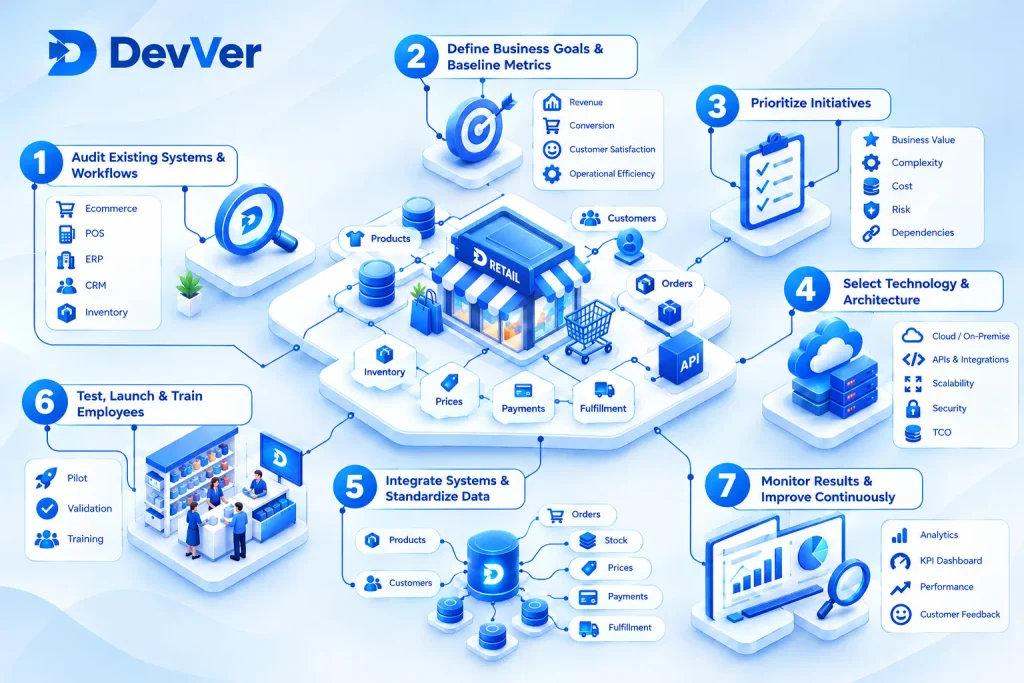
A successful digital transformation in retail industry strategy starts with measurable business goals and progresses through manageable implementation stages. Retailers should prioritize the problems with the clearest operational or commercial impact before committing to major technology investments.
Step 1: Audit Existing Systems and Workflows
Document the systems that manage ecommerce, POS, ERP, CRM, inventory, warehouses, payments, customer support, and reporting. Identify duplicated data, manual handoffs, outdated applications, integration failures, and processes that frequently require correction.
Interview the employees who use these systems every day. Their experience often reveals operational issues that are not visible in management reports.
Deliverable: A current-state assessment listing business problems, system dependencies, data gaps, risks, and opportunities for improvement.
Step 2: Define Business Goals and Baseline Metrics
Set specific objectives before choosing technology. Goals may include reducing order cancellations, improving inventory accuracy, shortening fulfillment time, increasing checkout conversion, or reducing manual reporting effort.
Record the current performance of each selected metric. Without a baseline, the business cannot determine whether the transformation improved results.
Deliverable: A prioritized list of objectives, baseline measurements, target outcomes, and accountable owners.
Step 3: Prioritize Initiatives by Business Impact
Evaluate each proposed initiative based on business value, implementation complexity, cost, risk, and dependencies. Start with projects that address significant problems and provide a practical path to measurable improvement.
For example, a retailer with frequent overselling should investigate inventory data and channel synchronization before investing heavily in advanced personalization.
Deliverable: A phased roadmap with clear priorities, dependencies, resource requirements, and success criteria.
Step 4: Select the Right Technology and Architecture
Determine whether existing platforms can meet requirements through configuration, integration, or modernization. Use custom development when the retailer needs capabilities that standard products cannot support efficiently.
Assess API availability, data ownership, scalability, security, vendor dependencies, total cost of ownership, and support requirements. Technology decisions should fit the business model and operating processes rather than follow trends.
Deliverable: An approved solution architecture and implementation plan. Retailers evaluating a wider technology overhaul can connect this work to their software development services and application modernization strategy.
Step 5: Integrate Systems and Standardize Data
Define how products, customers, inventory, prices, orders, payments, and fulfillment statuses will move between systems. Establish a reliable source of truth for each important data type and specify how systems handle failed updates, duplicate events, and conflicting records.
Implement and test the integrations in stages. Validate normal transactions as well as exceptions, such as refunds, split shipments, cancelled orders, stock adjustments, and temporary service outages.
Deliverable: Tested integrations, documented data rules, monitoring, and error-handling procedures.
Step 6: Test, Launch, and Train Employees
Test the solution against real business scenarios before a full rollout. Validate data accuracy, performance, access permissions, transaction handling, and recovery procedures.
Train store associates, warehouse staff, customer support, merchandising teams, and managers according to their roles. A system is not operationally successful if employees cannot use it correctly or understand the new workflows.
Where possible, begin with a pilot store, region, product category, or sales channel. Use the pilot results to correct issues before expanding.
Deliverable: A validated release, trained users, documented procedures, and a controlled rollout plan.
Step 7: Monitor Results and Improve Continuously
Compare post-launch results with the original baseline. Review technical performance alongside business metrics, including order accuracy, stockouts, conversion, fulfillment costs, and customer satisfaction.
Investigate missed targets and distinguish between technology issues, process gaps, data problems, and adoption challenges. Use the findings to refine workflows and prioritize the next phase of investment.
Deliverable: A performance dashboard, regular review cycle, and roadmap for continuous improvement.
Retail Digital Transformation Roadmap
The timeline below is an illustrative planning model, not a universal delivery estimate. Actual timing depends on the number of systems, integration complexity, data quality, security requirements, and organizational readiness.
| Phase | Main activities | Expected output |
| Assessment | Audit systems, map workflows, establish baseline metrics | Current-state analysis and business priorities |
| Strategy | Define target outcomes, scope, budget, and dependencies | Approved transformation roadmap |
| Solution design | Select platforms, plan integrations, define data ownership | Technical architecture and delivery plan |
| Pilot implementation | Build or configure prioritized capabilities and test integrations | Validated pilot |
| Rollout | Train teams, deploy in stages, monitor issues | Operational adoption across the agreed scope |
| Optimization | Review KPIs, resolve bottlenecks, plan improvements | Continuous improvement backlog |
Retailers should not treat the roadmap as a one-time technology project. Digital transformation is an ongoing business capability that evolves as customer expectations, channels, and operational requirements change.
KPIs to Measure Retail Digital Transformation Success
Technology implementation is only one measure of progress. Retailers need performance indicators that show whether the changes improve customer experience, operational efficiency, and commercial outcomes.
| KPI | What it measures | Why it matters |
| Ecommerce conversion rate | Percentage of website or app sessions that result in purchases, based on the chosen analytics definition | Helps evaluate shopping and checkout performance |
| Cart abandonment rate | Share of initiated carts that do not result in purchases | Highlights checkout friction and purchase barriers |
| Inventory accuracy | Agreement between recorded and physically verified stock | Indicates inventory data reliability |
| Stockout rate | Frequency or share of product availability failures | Helps assess replenishment and inventory planning |
| Order cancellation rate | Share of orders cancelled under the chosen reporting definition | Reveals availability, processing, and fulfillment issues |
| Order fulfillment time | Time from the defined order event to fulfillment or dispatch | Measures operational speed |
| On-time delivery rate | Share of deliveries meeting the promised delivery window | Evaluates fulfillment reliability |
| Average order value (AOV) | Revenue divided by the number of orders, using a consistent definition | Helps assess basket value and merchandising performance |
| Customer retention rate | Share of customers retained over a defined period | Measures repeat business and relationship strength |
| Return rate | Share of orders or items returned under the selected method | Helps identify product, sizing, quality, or expectation issues |
| Cost per order | Relevant fulfillment and processing costs divided by orders | Shows whether operations are becoming more efficient |
| System uptime | Availability of a defined application or service | Measures reliability of critical digital operations |
How to Use These KPIs
Choose a focused group of metrics that align with the transformation objectives. A project designed to improve inventory visibility should prioritize inventory accuracy, stockouts, cancellations, and fulfillment performance. A checkout modernization project should prioritize conversion, checkout completion, payment failures, and page performance.
Define each KPI consistently, assign ownership, and review results over comparable periods. Where seasonal demand affects performance, compare equivalent periods or account for the seasonal effect. This produces a more credible view of impact than relying on a single before-and-after figure.
Security, Privacy, and Scalability in Retail Technology
Retail platforms handle sensitive business and customer information, including account details, order histories, addresses, and payment-related data. As systems become more connected, security must be built into the architecture, integrations, access controls, and operating procedures.
Key safeguards include:
- Access control: Give employees and applications access only to the information and functions they need.
- Data protection: Protect sensitive information in transit and at rest, according to the data and applicable requirements.
- Payment security: Evaluate payment flows and applicable controls against the PCI Data Security Standard.
- Monitoring and response: Log important events, monitor suspicious activity, and establish incident-response procedures.
- Backup and recovery: Define recovery objectives and test the restoration of critical systems and data.
- Privacy governance: Collect and retain customer data for defined purposes, apply appropriate controls, and meet applicable legal requirements.
- AI governance: Review data quality, model behavior, access, transparency, and human oversight for AI-supported decisions.
The NIST Cybersecurity Framework provides guidance for organizing cybersecurity risk management. Retailers should adapt security controls to their business model, systems, data exposure, and regulatory obligations.
Scalability also requires technical discipline. Modular architecture, documented APIs, automated testing, monitoring, and capacity planning help retailers introduce new capabilities without destabilizing critical operations. Security and scalability should be design requirements from the beginning, not fixes added after launch.
Choosing the Right Retail Software Development Partner
Retail transformation often requires more than a new ecommerce platform. It can involve legacy modernization, API development, inventory synchronization, order management, customer data integration, analytics, and mobile applications.
A suitable technology partner should understand how retail workflows connect and how technical decisions affect daily operations. Evaluate potential partners on their ability to:
- Map retail processes and identify the root cause of operational problems.
- Integrate ecommerce, POS, ERP, CRM, OMS, and inventory systems.
- Develop custom applications when standard software cannot meet specific requirements.
- Design secure, scalable architectures that support additional channels and locations.
- Establish testing, monitoring, documentation, and support procedures.
- Measure delivery against business outcomes rather than software features alone.
Retail software development should be tied to clear requirements, agreed deliverables, and measurable success criteria. The partner should explain trade-offs, risks, dependencies, and ongoing maintenance costs before implementation begins.
For businesses that need to connect existing applications or build new capabilities, custom software development and API integration can help close functional gaps while preserving useful investments in existing systems. The best solution is the one that solves the operational problem reliably and remains maintainable as the business grows.
Build a Connected Retail Business
Digital transformation gives retailers a practical way to connect customer experiences with the systems behind them. Integrated commerce platforms, accurate inventory data, automated workflows, analytics, and secure infrastructure help businesses manage complexity and make better decisions.
The most effective approach begins with a clear operational priority, establishes baseline performance, and delivers improvements in measurable stages. Retailers do not need to replace every system at once. They need a coherent technology strategy that removes disconnected workflows, supports customers across channels, and gives teams reliable information.
A connected retail operation creates a stronger foundation for growth because products, orders, inventory, customer interactions, and business reporting work together. With the right roadmap and implementation discipline, digital transformation becomes an ongoing source of operational improvement not just a technology upgrade.
Frequently Asked Questions
1. What is digital transformation in retail?
Digital transformation in retail is the use of connected digital technologies, integrated systems, and improved workflows to enhance customer experiences, retail operations, and business decision-making. It can include ecommerce modernization, inventory management, POS and ERP integration, automation, analytics, and omnichannel commerce.
2. Why is digital transformation important for e-commerce businesses?
Digital transformation helps ecommerce businesses improve shopping experiences, connect online sales with inventory and fulfillment, automate order processing, and use customer and sales data more effectively. It also gives businesses a stronger technical foundation for expanding product catalogues, channels, and order volumes.
3. What technologies are used in retail digital transformation?
Common technologies include ecommerce platforms, POS systems, ERP and CRM software, order management systems, inventory management tools, APIs, cloud infrastructure, business intelligence, artificial intelligence, automation, and mobile applications. The right combination depends on the retailer’s business goals and existing systems.
4. How does digital transformation improve retail operations?
It connects data and workflows across sales, inventory, orders, fulfillment, and reporting. This helps reduce duplicate data entry, improve stock visibility, streamline order handling, and give teams faster access to operational information. Results should be measured against defined baseline metrics.
5. What is omnichannel retail, and why does integration matter?
Omnichannel retail connects customer experiences across channels such as physical stores, websites, mobile apps, and marketplaces. Integration matters because it helps keep product information, stock availability, orders, and customer interactions consistent across those channels.
6. How does AI help retailers?
AI can support demand forecasting, product recommendations, customer service automation, fraud detection, marketing analysis, and inventory planning. Retailers should select use cases with clear business value, reliable data, appropriate oversight, and measurable performance targets.
7. What is the role of custom software in retail digital transformation?
Custom software addresses requirements that standard platforms cannot support efficiently. It can connect legacy applications, automate specialized workflows, create employee tools, support unique order-routing rules, and extend existing retail platforms without requiring every system to be replaced.
8. How can retailers integrate POS, ERP, and ecommerce systems?
Retailers typically use APIs, middleware, platform connectors, or event-driven integration to exchange data between systems. Successful integration requires defined data ownership, consistent product and order identifiers, error handling, transaction monitoring, and testing for returns, cancellations, stock adjustments, and other exceptions.
9. How should a retailer measure digital transformation success?
Retailers should select KPIs tied to their objectives. Relevant measures include inventory accuracy, stockout rate, order cancellation rate, ecommerce conversion, fulfillment time, on-time delivery, customer retention, cost per order, and system uptime. Baseline measurements are essential for evaluating improvement.
10. How can a retailer start digital transformation without replacing every system?
Start by auditing existing systems and identifying the operational problem with the greatest business impact. Set baseline metrics, prioritize a manageable initiative, integrate or modernize the systems involved, and test the solution through a pilot. Expand only after the results and operational readiness have been validated.
